
When I was studying water-related issues and exploring how other countries addressed them, my research brought me to Singapore and to the towns and cities of the State of New York. I conducted observations and interviews hoping to learn innovative engineering solutions. But what struck me most was not just the technical side—it was something far beyond my field.
I saw how governance played a pivotal role in transforming Singapore into a global model for Water Resources Management. That discovery sparked a deeper curiosity: how did good governance make such transformation possible?
Back in the Philippines, I reviewed our water management landscape. We have world-class engineering concepts and brilliant technical minds. We even have a comprehensive set of laws intended to manage and protect our water resources. True, some laws are outdated and need revision, but even if implemented as-is, they could still help us become a water-secure nation.
Yet ironically, despite being rich in freshwater sources, we suffer from water scarcity.
So I dug deeper. How could Singapore—a country with virtually no natural freshwater—manage to produce more usable water than we do?
The answer became clearer the more I looked beyond engineering and into leadership. It wasn't just about systems or technologies. It was about the kind of governance that consistently makes the right decisions, led by people who are qualified, competent, and accountable.
In Singapore, they elect the best—from the lowest post to the highest. It’s not a perfect system, but there is an unspoken standard: leaders must be the best available. Mediocrity is not acceptable.
In contrast, the Philippines does the opposite. We elect individuals regardless of competence—sometimes even the least qualified. As long as they can read and write and hold Filipino citizenship, they are legally eligible to govern over 100 million people. And then we expect excellent outcomes from poor leadership. Where is the logic in that?
What’s even more tragic is that the framers of our Constitution take pride in this inclusivity, yet failed to require brilliance, integrity, or leadership capacity as minimum qualifications. The result? A circus run by jokers—at almost every level of government.
Let’s look at this side-by-side:
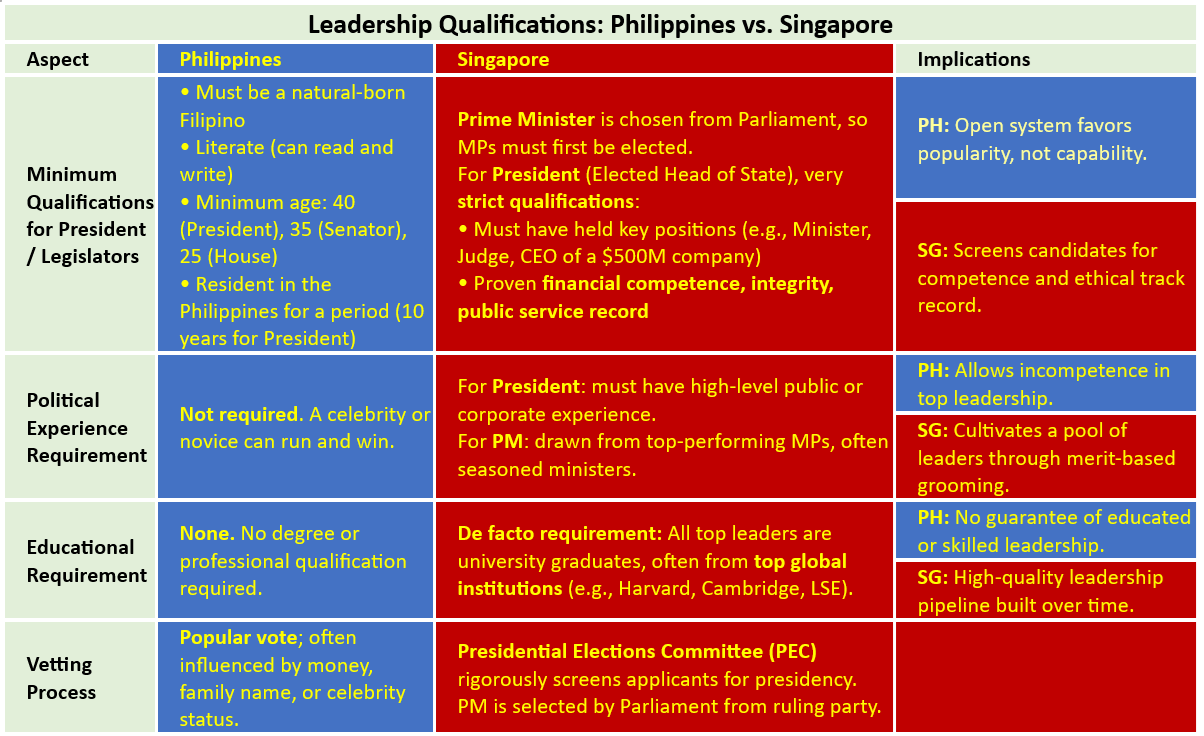
This is not just a table—it’s a mirror. And what it reflects is painful.
We do not just have a leadership problem; we have a constitutional design flaw that allows incompetence to rise and lead. And the consequences are everywhere: in our traffic, our water, our education, our poverty levels.
Just look at some of the numbers:
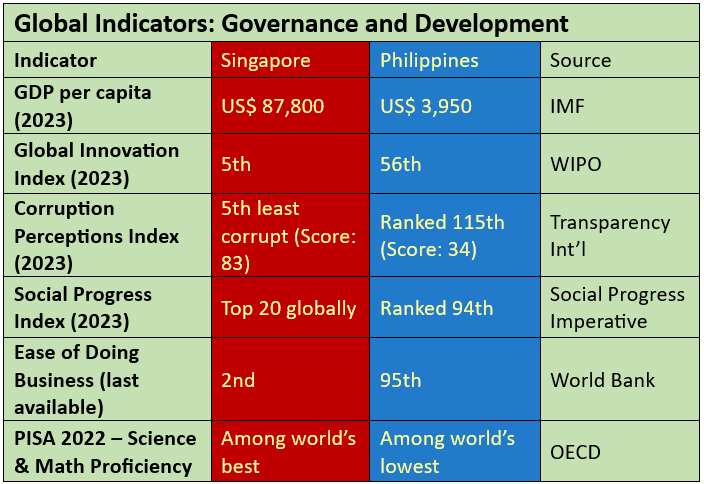
Each indicator is more than a number—it is the result of policy, and policy is the product of leadership. And in the Philippines, our leadership pipeline is broken by design.
I’ve always been fascinated by Singapore’s rise—from a struggling slum to a global economic powerhouse. Every time I reference it in my talks and writings about development, someone always responds, “But Singapore is small and manageable.”
Perhaps. But the real difference lies not in the size, but in the standards.
How High Standards at the Top Shape the Entire Government
In Singapore, when national leaders are selected based on merit, integrity, and executive experience, this mindset permeates every layer of government. Ministries are run by capable Permanent Secretaries with strong academic and administrative credentials. Promotions in the civil service are based not on proximity to power or family name, but on performance, innovation, and results. Mid-level managers are groomed for higher roles through structured programs and performance-based evaluations.
Leaders of agencies and departments are chosen from among the most capable professionals in their field. Recruitment of public servants—whether engineers, administrators, or policy makers—is highly competitive. There is pride in being a civil servant, and more importantly, the public has confidence in them. And because top leaders are competent, they set the tone and demand accountability across all government offices.
This culture of excellence does not stop at the bureaucracy. It influences the general public, shaping how citizens see their role, behave in public spaces, follow rules, and even define patriotism. The message is clear: You deserve good leadership, and you must live up to it too.
Now contrast that with the Philippines.
In our system, a barangay official with no background in governance can rise to become a Congressman or Senator—often through money, media exposure, or political inheritance. Government offices reflect this chaos: some run well despite leadership, many crippled because of it. Promotions are too often based on patronage, political connections, or compliance with the whims of those in power—not on public service excellence.
This trickles down to a civil service demoralized by inequity, corruption, and lack of direction. Even when there are good people in the system, they are trapped in a bureaucracy where the incompetent are tolerated, if not rewarded. How can agencies function optimally when their leaders were elected not because they were the best—but because they were the most popular or the wealthiest?
This is not merely an opinion. The results such as GDP per capita, innovation index, PISA exams, to name a few speak for themselves. Each indicator mentioned is more than a number—it is the result of policy, and policy is the product of leadership. And in the Philippines, our leadership pipeline is broken by design.
What if We Had a Presidential Elections Committee?
Imagine if the Philippines had a body like Singapore’s Presidential Elections Committee (PEC)—a vetting system that ensures only ethical, experienced, and competent candidates can run for top offices.
What would change?
-
Unqualified candidates would be filtered out before election.
-
Voters would choose among the most capable, not the most visible.
-
Leadership would improve, and with it, bureaucratic performance.
-
Corruption would be less tolerated, because competent leaders do not need to steal to appear effective.
-
Long-term planning would return, and so would public trust.
This isn’t fantasy. Singapore did it. We can, too—if we fix the way we choose our leaders.
I’ve always been fascinated by Singapore’s rise—from a struggling slum to a global economic powerhouse. Every time I reference it in my talks and writings about development, someone always responds, “But Singapore is small and manageable.”
Perhaps. But the real difference lies not in the size, but in the standards.
Singapore advanced because they chose the best. We fell behind because we don’t.